
Work Text:
In the days when Haraldr Hárfagri still ruled in Norway, there lived in Iceland a chieftain named Þráinn Eikenskjǫldr. He was Jarl of Hrafnafjǫrðr, the Raven's Fjord, in Iceland’s Easternmost shores. Rich were the lands his father Þrór had claimed, blessed by the gods with good fertile soil and waters teeming with fish. His hall stood proud upon a headland, looking out over the whale-road that brought traders with spoils from lands afar.
Þráinn had a son, Þórinn, who showed from boyhood the makings of a great man. Tall he grew, strong of arm and quick of wit, skilled with sword and words alike. In his fifteenth winter, his father gifted him with the family's greatest heirlom: Eikenskjǫldr. The Oak-Shield had been wrought by Þráinn’s grandfather from wood of a sacred oakley in Norway, before he left to settle on Iceland. Upon its face were carved the runes of protection, and set into its center was a stone of great beauty, smooth and shiny as glass. It was a jewel said to have fallen from the sky, a gift from the gods themselves.
“This shield has protected our line since your great-grandfather's day”, Þráinn told his son. “Guard it well, for in it resides the luck of our house”.
But the gods are fickle in their gifts, and what they bestow they may also one day reclaim.
In Þórinn's seventeenth winter, the earth began to groan like a wounded beast. Smoke rose from the mountain called Smauganfjall that had slumbered peacefully through all the years of settlement.
One night Smauganfjall awoke in wrath.
It was like the breaking of the world, or worse, for it brought only destruction in its wake.
The mountaintop split open with a roar and fire erupted from within turning night into a hell-light of red and orange.
Þráinn acted swiftly, rousing his household, commanding all to flee. But the fire-river moved with terrible speed, and the night was filled with confusion and terror. In the chaos, as folk gathered what they could carry and drove their livestock before them, a section of the hall's roof collapsed. Þráinn and his wife Frøydís and his youngest son Frérinn were trapped within, buried beneath the burning timber.
The young Þórinn had to be dragged away from the flames in his attempt to save them.
And it was so that being barely more than a boy Þórinn found himself suddenly chieftain of what remained of his people.
Of the hundred souls who had called Hrafnafjǫrðr home, fewer than forty survived.
They fled north along the coast with only what they could carry on their backs, watching behind them as the fire-river swallowed their fields, their homes, their dead.
For three days they traveled, the sky dark with ash, the air thick with the smell of sulfur. Children wept. The old could barely walk. And Þórinn, his face blackened with soot and streaked with tears he would not acknowledge, led them on, speaking words of encouragement though his own heart was broken, making decisions with a certainty he did not feel.
In his back, safely bound and tied, he carried Eikenskjǫldr, the Oak-Shield, the only thing of value he had managed to save from the hall. But when at last they stopped to rest, and he had time to examine the shield by daylight, he found that a crack had appeared in wood. And the star-stone at its center was gone.
Þórinn wept openly then. For he understood what the loss meant: the luck of his house was gone too. The gods had turned their faces away.
But continue with their lives they must, anyway.
After walking for a week, the survivors of Hrafnafjǫrðr arrived to a place where the land rose into tall blue-dark peaks against the sky. Þórinn claimed the land and named it Fjallin Blár, the Blue Mountains.
The first were very hard years. The winters were bitter. The harvests scarce. The cattle weak. Slowly, painfully, Fjallin Blár grew from a desperate refuge into a true settlement.
Yet Þórinn never forgot what was lost. The memory of his parents' death haunted him. The absence of the star-stone gnawed at his spirit on his many sleepless nights. In his despair, he became a man deeply given to signs and portents.
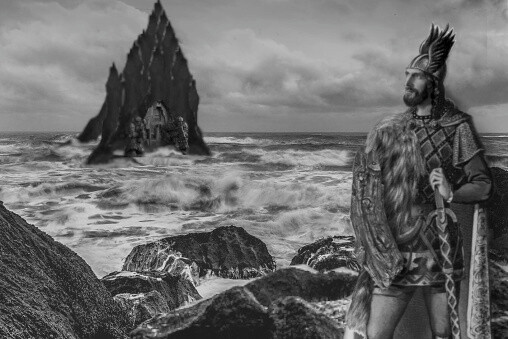
And so when Óoina the Seer, who had served his father and survived the fire-mountain's wrath, spoke of her dreams, Þórinn heeded them as a drowning man heeds the sight of shore.
The old seer had dreamed for three nights running, and each dream was the same: he saw Þórinn standing before the ruins of the old hall. In his hand he held the Oak-Shield, whole and unbroken. And at its center gleamed the star-stone, restored. Beside Þórinn stood a man whose face Óoina could not see, but upon whose bare chest was marked the sign of an acorn, the oak's seed, from which the mightiest of trees grows.
Other portents were consulted. Runes were cast. Sacrifices were made. And each divination pointed in the same direction: westward, across the whale-road, to the lands of those who believed in the White Christ upon the Cross.
So it was that in the spring of that year, Þórinn Eikenskjǫldr gathered his finest warriors and sailed west. Not merely to raid for silver and slaves as other men did, but to find the one whose existence had been promised by the gods, through whom his house's luck might be restored.
Most of his men thought only that they raided the Christian lands for plunder. But Þórinn and those closest to him, searched with different eyes, looking not at treasure but at the faces and bodies of those they captured, seeking always the sign that had been promised.
They raided along the Coast and found nothing. They put many villages to the torch and examined every living soul, but none bore the mark they sought. Þórinn began to doubt, began to wonder if Óoina the Seer had been wrong, if the gods mocked him, if his luck was so broken that not even prophecy could restore it.
Then they came to the monastery at Tuckborough.
The raid was swift and brutal. The monks had little defense against armed warriors. Some fled, some fought with whatever came to hand, most died. Þórinn's men spread through the buildings seeking treasure.
In the scriptorium, Fílinn, son of Þórdiss, Þórinn’s sister, found a monk hunched over his writing. He tried to run but Fílinn caught at his robe and the rough cloth tore, pulling away from the neck and shoulder.
And there, pale against paler skin, was a birthmark: an acorn, perfect in its shape, positioned directly over the heart.
They brought the young monk before Þórinn. The boy was terrified, understanding nothing of what was said, knowing only that his brothers lay dead and he alone was being spared for reasons he could not fathom.
He was perhaps twenty winters old, weak as a sapling, with the soft hands of one who had never wielded anything heavier than a pen.
Þórinn stared at his trembling form. So small he seemed, so powerless. How could such a one be the key to restoring what was lost? How could this foreign boy, who worshipped a dead god nailed to wood, serve the purposes of the Allfather?
But the mark was there. The prophecy was clear. And Þórinn was not a man to ignore the gods' will, not after all he had suffered for lack of their favor.
So Bilbo, whose name Þórinn did not yet know, nor cared to learn for quite some time, was taken aboard the drakkar, and carried away across the whale-road toward a fate neither he nor his captors understood.