
Chapter Text
Thais do have a certain traditional way of doing a wedding ceremony, but what matters the most is the preferences of the married couple. Nowadays, one can choose to do whatever they want with their wedding! A mixture of Thai and Chinese or Western happens all the time. Weddings without any traditional Thai ceremony elements are also an option, as is simply registering.
In this chapter I will talk about the Thai (Thai-Buddhist) style and a little bit of mixed style.
But first, let get something out of the way.
Yes, traditionally, the wedding ceremony is designed for a straight couple. So what should a queer couple do?
The answer is whatever they want!
They could pick a role. They could be two brides, but one plays a groom role for when the ceremony requires it. Many couples do that. Or they could adjust some details, cut something out, add something in, or bend some part. It's entirely up to them. Straight couples adjust things all the time too. Don't see the tradition as a rigid rule you have to follow even if you are unhappy, see it as a template you can customize to suit your needs.
Now, let's start.


Thai Wedding Ceremony
When a man and a woman decide to marry, The men will send his parents or recruit elderly men who have a high position in society or may be their respected elder relatives, known as "tâo gàe", to approach the woman's parents in order to ask the woman to be his bride and be the one who talks about the dowry. When the woman's parents agree, they will go find the auspicious day for the wedding based on the pair's information, which is mostly their date of birth. After the date is set, then they will start organizing for the wedding ceremony.
Since the "good" date for a wedding in each month/year (according to astrology) does not come that often, the popular venue would be packed. So it's better to plan ahead if you happen to want a big/glamorous wedding.
Order of the ceremony
(For a completed-in-one-day course. There are other options/ways of organizing a wedding.)
1. Buddhist Ceremony (พิธีสงฆ์ phithi song)

As I say in chapter 7, we Thai Buddhists will invite monks to be in a ceremony for an event like this. For the wedding ceremony, in the past, it was popular to invite them in an even number, four for example, but now nine is the most popular because nine in Thai is homonym with the word that means thrive, and by counting the presiding Buddha images as the ten, they will be in an even number.
In my eyes, the highlights are first when the pair put food into the monks' alms bowl together using one ladle. It is believed that whoever gets to hold the ladle by the top or neck will be superior to the other in the pair. In some cases, they will switch between themselves as a symbol that they will be equal.
And second, when the groom receives forehead anointing to bless the marriage from the monk first and gives one to the bride himself, with the hands of the monk holding and guiding his. In some cases, forehead anointing will be done by an elder the married couple respects instead of the monk. And in some people's opinion, forehead anointing does not count as a part of the Buddhist ceremony, so it won't happen in this step.
2. Khan Mak procession (แห่ขันหมาก hae khanmak)
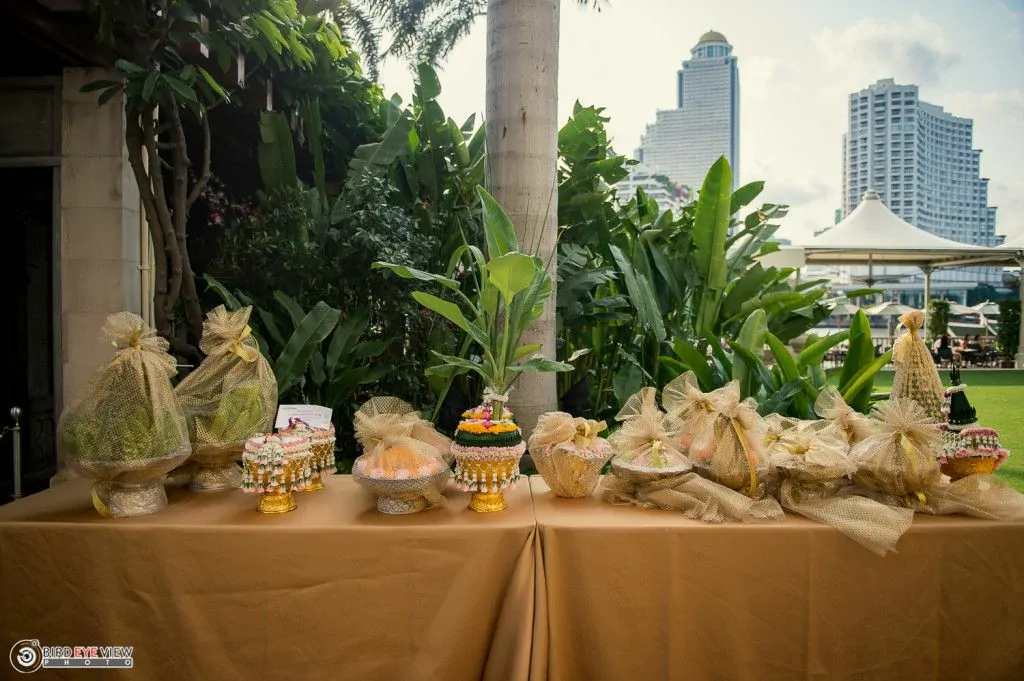
Khan means a type of tray/bowl. Mak means betel nut. Together 'Khan Mak' refers to gifts from the groom to the bride's house.
The amount of trays and gifts can be varied depending on the groom's budget, their manpower, and the aesthetic. 9 pairs or 19 pairs (each pair mirroring each other with some exceptions) seems to be the popular choice, but the smallest number I see is only 2 trays that are not mirroring each other.
The Khan Mak parade is separated into two types, Khan Mak Ek (ขันหมากเอก-primary) and Khan Mak Tho (ขันหมากโท-secondary). There are also banana tree and sugarcane that some sources put in Khan Mak Ek, some put in Khan Mak Tho, and some put in their own categories and not in either Ek or Tho.
Traditionally, after the wedding, the banana tree and sugar cane will get planted at the newlyweds' house as a wish for the couple to have a sweet, flourishing life with many children. At the time when the banana tree and sugar cane arrived at the bride's house, there could be a little game where the person on the groom's side who carried it refused to give it to the bride's side until they got some 'water.' It could actually be water for watering the plant, but apparently in many cases it would be alcohol to satisfy the plant carrier rather than the plant.
Trays in the Khan Mak Ek category are
1. Khan Mak Ek tray: betel leaves, silver bag, gold bag, auspicious grains, mung beans, black sesame, unhusked rice, puffed rice, and money envelopes.
2. Incense and candles tray: candles and incenses. They will get used at the later step (the fifth step, accept Wai).
3. Dowry tray: gold, jewelry, and various valuables depended on their prior agreement.
4. Ring tray: Rings of the bride and groom. Each ring may have its own tray, or they may share one tray.
Trays in the Khan Mak Tho category are containing less important things like auspicious desserts and auspicious fruits.
In the countryside they might do an actual procession with a Khan Mak parade pass through their community to the bride's house. As for the city, they might skip it or change the location the parade starts and make it a lot shorter due to the fact that in the city there isn't enough space for it.
If they do have a parade, the groom's side will start someplace not too close to the bride's house (or the wedding site), cheer three times to signal everyone to start walking, and then another three near the end to tell the bride's side to get ready.
The cheer sounds like this
When the parade arrives at the bride's house, the bride's relatives will start barring the groom from entering the house by using some type of string as a gate.
Traditionally, there are three gates in total, but there can be more.
The groom and guests on his side must play games that the bride's side wants in order to pass the gate. It can be answering the question about the bride. The groom shouts out his love for the bride, pushes up, or anything they want.
The groom's side will also give away some money in addition to winning the games. Most of the people who participate in barring the gate are the younger generation, like siblings or friends of the couple.
3. Marriage proposal ceremony (สู่ขอ sòo kŏr) and dowry counting ceremony

In the beginning the bride will not be present on scene. Later, after the parents express their consent for the marriage to happen, the bride's parent will go bring the bride out into everyone's eyes, and then the Sinsod counting will begin.
Sookor is asking for permission to marry from the bride's parents. And as that implies, in some cases it might even be done without the bride's consent, but fortunately that is not a common occurrence anymore. I can't say it's absolutely not happening, but it's not normal for sure.
The action of Sookor traditionally happened quite some time before the wedding. But in the present it is a part of a less than one day marriage ceremony.
The actual agreement will be reached since before, and they will just act their role out.
The parents and whoever acts as a tao gae will pretend to negotiate, and when they come to an agreement, the dowry which is in the Khan Mak they have been carrying, would be give out and the bride's side will pretend to count them. during the process they will also sprinkle various flowers with popped rice, which also came with one of the Khan Mak, on the dowry and bless the pair.
Lastly, the bride's mother will pick up the sinsod using cloth to wrap it, place it upon their shoulder, and act as if they are unable to carry it because it is very heavy.
Other than the act and dialogue, all of the props used during Sinsod counting will also signify something auspicious.
For example, one of the flowers used, the crown flower, its Thai name is synonymous with the word love, or the globe amaranth, its Thai name is blooms that know no withered.
The bride's parents can take those sinsod for themselves (frowned upon) or give them to only the bride, or only the groom, or both the bride and groom to share as a fund for their new family.
4. engagement ceremony

The engagement ceremony was originally intended to give men and women the opportunity to study and adjust to each other, so it has been held before the wedding for quite some time, but nowadays, the engagement ceremony is commonly held on the same day as the wedding date. which makes everything happen and over all in one day.
In the process of giving the engagement ring, the groom first puts the ring on the bride, and then the bride bows down to the groom. Like this Link at 9:39
After that, it's the bride who will put the ring on the groom, followed by the couple bowing down to pay homage to their parents.
5. Accept wai (รับไหว้ Rap Wai)
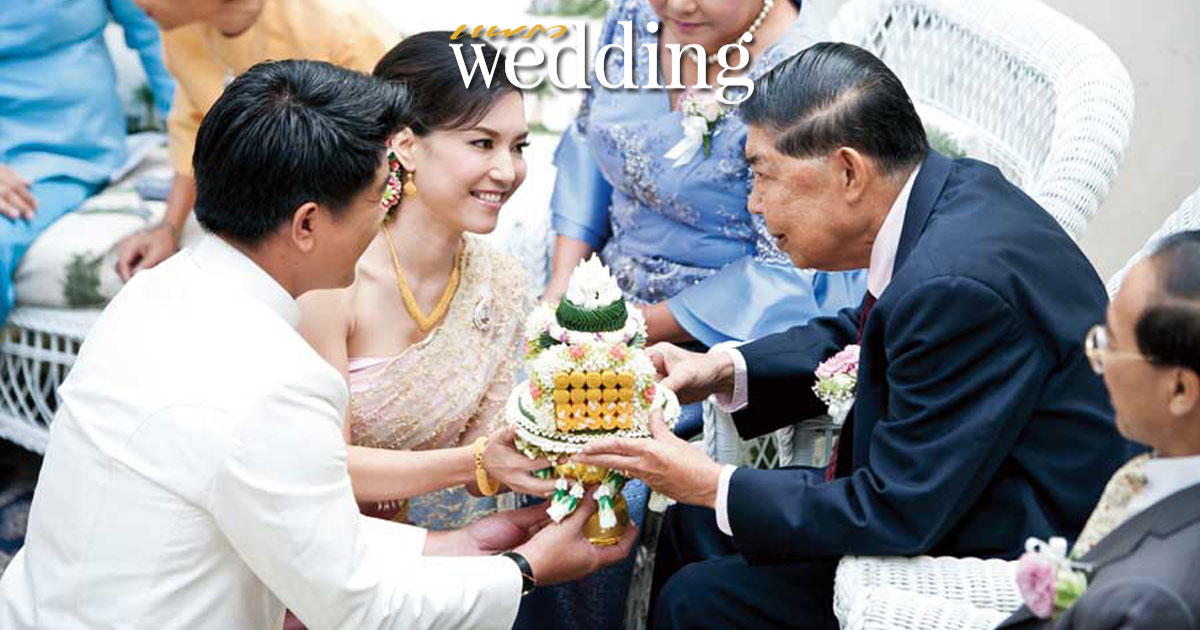
In this step, the newlyweds will pay their respects to their parents and senior relatives, and they will offer a gift or blessing as a response. The meaning of this is to ask the parents and relatives of both the bride and groom to acknowledge and look after them as a new member of their partner family.
On this step the couple will bowing down with their hands close (like when you wai). 3 times for the parents and grandparents and once for others. After bowing down, the couple will hand a raft of incense sticks to the elders. They will take it and then tie the bride and groom's wrists with holy thread for good fortune and as a symbol of being a member of the family, along with giving blessings and money envelopes as gifts for the newlyweds. Other valuables will also be given as a blessing and as funding for them to build a family together.
6. Water pouring ceremony (รดน้ำสังข์ rod nam sang)

It's different from the other water pouring ceremony I talk about in chapter 7, but I don't know what other word I should translate this one to. This one, the water will be pouring from the Valambari Shank.
The ceremony began with incense and candles being lit to honor the Three Jewels. The newlyweds sit on a bench, preparing to receive holy water, which is thought to be a life blessing. The honor guest (prathan: chairman, president, honor guest) will put the nuptial good luck thread on the newlyweds' heads and anoint their foreheads, and then the holy water pouring will start in the order of seniority, one by one. Most of the time, the people who get to do it are the ones who are already married, not children or teenagers. When it's over, the honor guest will remove the nuptial good luck thread, which must be taken off from both the groom and the bride at the same time, and roll it all together to put it on the groom's hand or the bride's hand, along with congratulating the pair.
7. Make a bed ceremony and sending bride and groom to the nuptial chamber
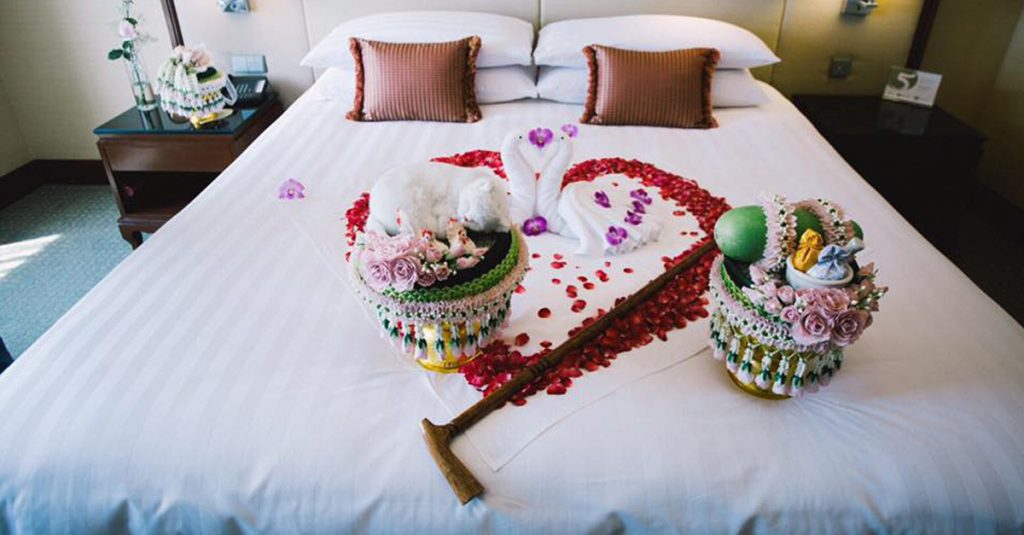
There are many alternative names for this step.
- พิธีปูเตียงเรียงหมอน—Bed-making and pillow-arranging ceremony.
- พิธีร่วมเรียงเคียงหมอน—I'm not sure how to translate it, but basically it is called a ceremony to join in bed and lay side by side.
- พิธีปูที่นอน—Bed making ceremony (but different word from the first)
- พิธีเรียงหมอน—pillow-arranging ceremony. (The word เรียงหมอน—pillow-arranging is also a name of a lunar calendar's day that is good for weddings.)
- พิธีส่งตัว—The send-off ceremony
- พิธีส่งตัวเข้าหอ—The send-off to the nuptial chamber ceremony
- พิธีแลกที่นอนบ่าวสาว—The bride and groom's bed exchange ceremony (refer to a particular substep. Here a link to a script for that step. https://praewwedding.com/thai-wedding/35250 The green text is the english translation)
When it's an auspicious time, their family will prepare rice, flowers, and other things according to the beliefs to sprinkle on the bed where the newlyweds will sleep. The bed sheet they use in the ceremony must be the newly bought one. In the ceremony, the elders, whom both sides respect, will make a bed and arrange the pillows. The requirements for those who performed are for them to be married couples who were rightfully married according to tradition and have a good, long married life and also be accepted in society as ethical and good people. The purpose of this ceremony is for auspiciousness and to give a good example of a good marriage for the newlyweds.
After this, the ceremony is considered over. Many people usually have a party at some point, but it's up to their personal preference.
*This one is the central Thai one. It normalizes the most since it is officially the center of the country. In other locations, the details and order of some of the steps may vary depending on the local customs. Or even have some step that is different entirely. For example, in Isan, there is a step where the bride and groom will feed boiled eggs to each other, which is a step other places don't have.
If you want other sources, these links below are for you.
https://learnthaiwithmod.com/2013/09/thai-tradition-wedding-ceremony/
https://www.weddinglist.co.th/blog/8-steps-of-thai-wedding-ceremony/
https://www.thethailandlife.com/thai-wedding-ceremony
https://www.thailandfoundation.or.th/culture_heritage/thai-wedding/
https://www.vivathaiwedding.com/thai-traditional-weddings
Thai (Buddhist?)+ Chinese wedding ceremony
It can be done in many different ways depending on whether they want more Thai or more Chinese elements, but I think the most common way to go about it was by adding a tea ceremony and adjusting some details, such as the content of Khan Mak.
Tea Ceremony
It is a Chinese tradition to pay respect to the elderly. The bride will be prepare a teapot and a teacup, and the elderly relatives who are attending the ceremony will sit in order of seniority. The groom's relatives will sit on the left. The newlyweds must sit together at the start of the ceremony. They will kneel down and pour tea into a cup, place it on a tray, and lift the tray with both hands at the same time. and send it to the attendee to drink until the cup is empty. Then elder relatives will bless them and give gifts, and the newlyweds will give something in return. They can be general items like cushions, towels, or glassware. At the end of the tea ceremony The newlyweds will eat Khanom Ei and Khanom Bua Loi together to symbolize sweet love.
The tea ceremony might happen after the wedding day, like how it happens according to Chinese tradition, or it might be combined with the accept wai step as they have the same purpose.
Or it can be anytime they want. My parents did it before the wedding day. It sounds like they do it when they get engaged, sometime before the wedding. It also appears that no one has a real, organized plan for how the wedding should take place at that time.
Thai (Buddhist??)+ Western wedding ceremony
There isn't a standard one for this. What I can gather is that the first thing most people cut off from all the steps in a Thai ceremony is the Buddhist Ceremony, and they usually keep the Water Pouring Ceremony, but that is just my opinion, not a fact.
Other
- There is a concept about how a young couple who elope comes back to apologize to their parents after letting some time pass for their parents to cool down or better, after they have a baby.
Some does say that marriage ceremonies are a middle-class thing, and others usually just elope. The concept of virginity was something that became prominent because of western influences and not of Thai originally after all.
- Women who get engaged but didn't get to wed for any reason, whether it be the groom's death before they have the ceremony or they broke the engagement are called Mai Khan Mak (หม้ายขันหมาก) (Mai-widow). And it can be seen as a shameful or bad thing in the past.
- A wedding ring is a western influence, but a popular one. At this point, it's the norm for a married couple to have one. My grandparents didn't seem to have one, but my mom and all the other married people I pay attention to do. Teachers, my brother's friend, my friend's relatives, etc. All the media I consume also feature it.
- Traditional Thai weddings typically begin in the morning, so it gets called the morning ceremony (งานเช้า). After the morning ceremony, many couples will also have a party where they will have food and drink and wedding cake and flowers toss, similar to what is in the western media. And that party will be called an evening ceremony (งานเย็น).
- An arranged marriage is known in Thai as khlum thung chon(คลุมถุงชน), which is a word that derives from how people set up a cockfight. I find that quite funny.
- The popular locations for the wedding are at home (the bride's home is the tradition for many place) or hotel. A wedding studio is also a thing. All places that can be rented out are options.
- The wife's taking her husband's last name after marriage is the most common, but the opposite, or both of them keeping their own last names or even go creating their own new last name, is also an option. As for using both last names, it's not so popular among Thai couples, but it's what quite a few Thai-foreign couples want. This option can be a bit more difficult compared to the others due to its being out of the norm and the process of obtaining it can be confusing, so many people will choose to make their old last names into middle names as a way to keep them instead of actually trying to use both.
- Marriage register information is considered private information. You will be informed about your partner's status when you and your partner register together. As for other cases, you will need to file for a court's order to access that information.
- A before-wedding celebration such as a bachelor party or something similar does not exist in Thai culture, nor does an after-wedding celebration such as a honeymoon. One could choose to have it, of course. The concept is known through media, social networks, and any other way out there, it just not a tradition here.
- People like to get their marriage registration at Bang Rak District. Rak (รัก) means love, so it has a good meaning for a married couple. And by the same logic, there are a few other districts that are also popular or unpopular with the married couple too. For example, Bang Sue District, Sue (ซื่อ) means honest, strict forward, truthful, faithful (ซื่อตรง). A quality people want from their partner. So, a popular choice. Or Bang Phlat. Phlat (พลัด) means to stray away, to be separated from, thus making it unpopular.
- 9 auspicious Thai desserts. Wikipedia The desserts that are chosen to be in this set all have a somewhat good meaning word in their names. It's not only popular for a wedding but also for all kinds of auspicious occasions. The same concept with the reason why Bang Rak is a popular district to register a marriage. 9 (เก้า-kao) is also an auspicious number.
- A groom moving into a bride's family's house is a traditional way of Thai marriage. Each couple can do whatever they want, of couse. Buying a new place only for themselves is an appealing choice for many of those who can, but I want to point out that a groom marrying in is historically done and a very normal choice in Thai.
- Wedding outfit
- Link1
- Link2
- Link3 -groom
- Link4 -bride
- Link5 -bride
- Link6 -bride's/groom's mom
- Link7 -groom's friends
- Link8 -bride's friends
**About traditional Thai attires, many of them, contradicting to what their names may suggest, aren't that old of a tradition. The biggest influencer about to-day Thai dress is Queen Sirikit, the mother of the current king. They are designed based on older Thai culture but not entirely old–old.
- Best man and maid of honor are translated into Thai as เพื่อนเจ้าบ่าว and เพื่อนเจ้าสาว. Groom's friends and bride's friends.
- https://kidhaina.com/dowrycalculator.html <- a website created to help people calculate how much a dowry would be proper. You could translate the page if you want to use it. I try translated the page into English via the browser, and it is understandable.
- PorschArm Podcast talking about organizing a wedding⤵️
https://youtu.be/6j-VtE3wiDU?si=smzuLACaLcJWHKc7
- For Buddhist men, it is a tradition that they should have entered the monkhood before the wedding (just before the wedding in general doesn't have to be right before the date, and if you have ordained before, then you don't have to do it again specifically for the wedding), as it is believed to make them a better man. It's fine if they don't, though. Its not a big deal.
- It is common for people to invite classmates and coworkers to their wedding. It is also common for the parents of the bride and groom to have their own guests. It's kind of an old practice that people would cut out if they had a limited budget, tho.
- I have a conversation, and the other person wonders if there is any ceremony a couple would do for themselves in the case that they elope and can't have a wedding with all their family and friends. The answer is I don't think so. I never heard of one. For Thai Buddhists, at least. And since the point of the wedding is mainly about social acceptance, whether it is that each side's family accepts the other, an announcement so that everyone knows the couple as a marriage couple, or 'Hey, look how grand our wedding is!' etc. If you have to elope and the social did not accept your relationship, then there is probably no reason to do it. Most, if not all, of the ceremonies are kind of not possible to do without any family or friends to beging with.
- This link is a script for MCs who run a wedding. There are English translations for the part that the MC will speak out loud and some more. I think it could be helpful. ⏭️https://m.pantip.com/topic/38458358?⏮️
- A house that the newlyweds would move into after marriage is called เรือนหอ-ruen hor. The words Ruen and Hor separately do have meaning, and a similar one too. Ruen means something that is built with an elevated floor, walls, and roof. And Hor is a subset of Ruen. Together, Ruen Hor is a proper noun. The wedding night is called เข้าหอ-entering hor, that word hor is as in ruen hor. In Thai to Thai dictionary, the description of Ruen hor is a house built for a newlywed couple to live in. (Some say that traditionally the groom would build it on the bride's family's land.) When people say the word, I do think of a new house. But due to the modern practice of living together before marriage, our poor economy and common sense. A whole new house is, of course, not something you have to strive for.
- For the legal side of marriage, there is no full translation of the new law that gave marriage rights to the same-sex couples yet. But if you want to read the old one, this site provides it. https://www.thailandlawonline.com/thai-family-and-marriage-law/family-and-mariage-law-in-thailand-for-foreigners The change the new law makes is mostly about making the gender term a neutral one. For example, for an engagement law where its use was to be a man and a woman, they would change it to the one that proposed for the engaged and the one that accepted an engagement. Other than that, it mostly stays the same. Here another site ➡️ https://thailawonline.com/thai-family-law-explained/
Marriage registration
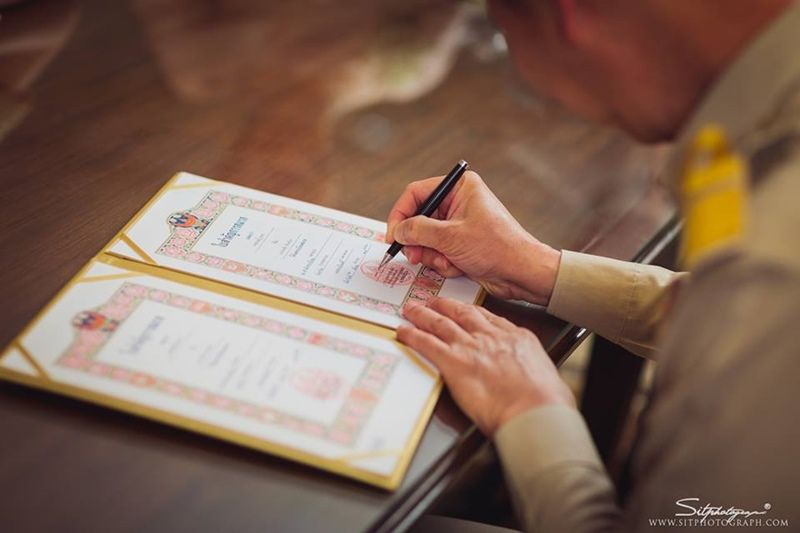
Things required
- ID card that has not expired or other cards issued by the government.

- House registration book (the one that your name is inside)

- Two people over 20 years old who will be your witnesses (with their ID)
- Proof of divorce (if there is)
- In the case that your previous marriage ended because of the death of your previous partner, proof of death
- If you have any children before registration of marriage, then a birth certificate and house registration book of the child are required.
- A form call คร. 1 It can be found at the place you will do the marriage registration, so you can fill it there, or you can download it online and fill it before going in if you want.
Place
- You can register your marriage at any registration office, Thai embassy or consulate
- You can arrange for the registration to happen at any place (your wedding site, for example) you wish for a low price of only a 200 baht fee plus commute expense for the marriage registration officer. The request should be put in at least 3 days prior to the date you want it to happen.
Time
- Office hours, which are 8.30 to 16.30 minus lunchtime, Monday to Friday minus public holiday.