
Chapter Text
The link below is to the Wikipedia page for Himmaphan. In there, there are also links to some of the himmaphan's creatures too.
https://en.m.wikipedia.org/wiki/Himavanta
This mythology is pretty famous and known across many regions, so there are a lot of resources in English already. So I think, just after a short introduction, anyone who is interested will be able to get more information quite easily.
There may be some differences between each region's version of it, but from what I saw, the differences are not that great. Especially if we look at only the character characteristics and not the entire epic.😆👍
นาค naga

Naga is, in short, a big fantasy snake. There are quite a few types or ranks of them. They have four ways that they can be born. Opapātika, born and grows up immediately. Sansetcha, born from ashes and accumulated matter. Chalapucha, born from the womb. And āṇṭhāca, born from an egg. Water is their element.
Personally, I suspect that some of Nega's tales are of different origins from Himmaphan's tale but got mixed up when cultures merged. And that is the reason why there are so many more tales about them than about other mythical beings. But right now, I'm too lazy to actually drive in and try to verify that theory.
- ordain บวชนาค
When a man wants to ordain, there will be a short period during the ordain ceremony when the will gets called naga. The story involved is that back then, when Gotama Buddha was still alive, there was a naga that wanted to be a monk, but, in the end, as one of its requirements was to be human, he couldn't. So we incorporated this into the ceremony to honor him. There is a step in the ceremony where the person who is ordain has to confirm that he is, in fact, a human, too. - Water amount
There is a belief that rain and water come from nagas, and the amount of water we get each year is determined by how many nagas are in charge of giving it. The more naga, the less water, because when there are more nagas, they start to be unwilling to do the work and want to push the burden on others. The maximum number of naga is seven per year. - Nakee is a pretty iconic drama about Naga. I never fully watched it, but if you are interested in Naga, this drama might be a good choice.
ครุฑ Garuda

Garuda's appearance is part bird, part human, with a human's torso and arms and a bird's head, wings, and legs.
Garuda is a sibling of a different mother of Naga and an enemy. Their mothers are also siblings and enemies. In fact, the reason why Garuda and Naga are enemies is because their mothers made it that way. There is a lot of family conflict in this story. Garuda also eats Naga.
Garuda is one of the king's symbols. Culturally, the king is an avatar of Narayana, and Garuda is Narayana's vehicle.
(I tried to translate the word for this concept, สมมุติเทพ, but it seems like there isn't any word in English that fits.)
- Queen Kakati กากี
Garuda Is one of the important characters in a famous tale about Queen Kakati. The story is that Garuda disguises himself as a man and goes to play a game with a king, and when he sees the king's wife, Queen Kakati, he wants her. So then he kidnaps her and brings her to his Chimplee Palace.
He slept with her there, and then one other guy also slept with her there. So the name Chimplee occasionally got used to hint at sexual things.
The name of the heroine also gets used for slut-shaming.
Just a warning if you want to read the whole thing. The story is heavily victim-blaming. All the guys in this story are trash, at least in the Thai version.
กินนร -kinnon

Kinnon is described as a half-bird, half-human creature, or a creature with a human-like body but with detachable wings and tail.
Kinnari and kinnara are words that are also used to refer to the same mythical creatures.
We have a lot of variant words for each Himmaphan's creatures, actually. I think it's for poetry.
- Suthon and Manora
Suthon and Manora is one of the stories that features Kinnon. Manora, the female protagonist, is a kinnari. She got captured one day when she removed her wings and tail during her bath with her sisters. After that, she met and fell in love with Prince Suthon. But later, Prince Suthon's family wronged her, making her flee back home. This tale is linked to the other tale. It says that Suthon and Manora's past lives are Phra Rod and Meree.
ปลาอานนท์ Anon fish
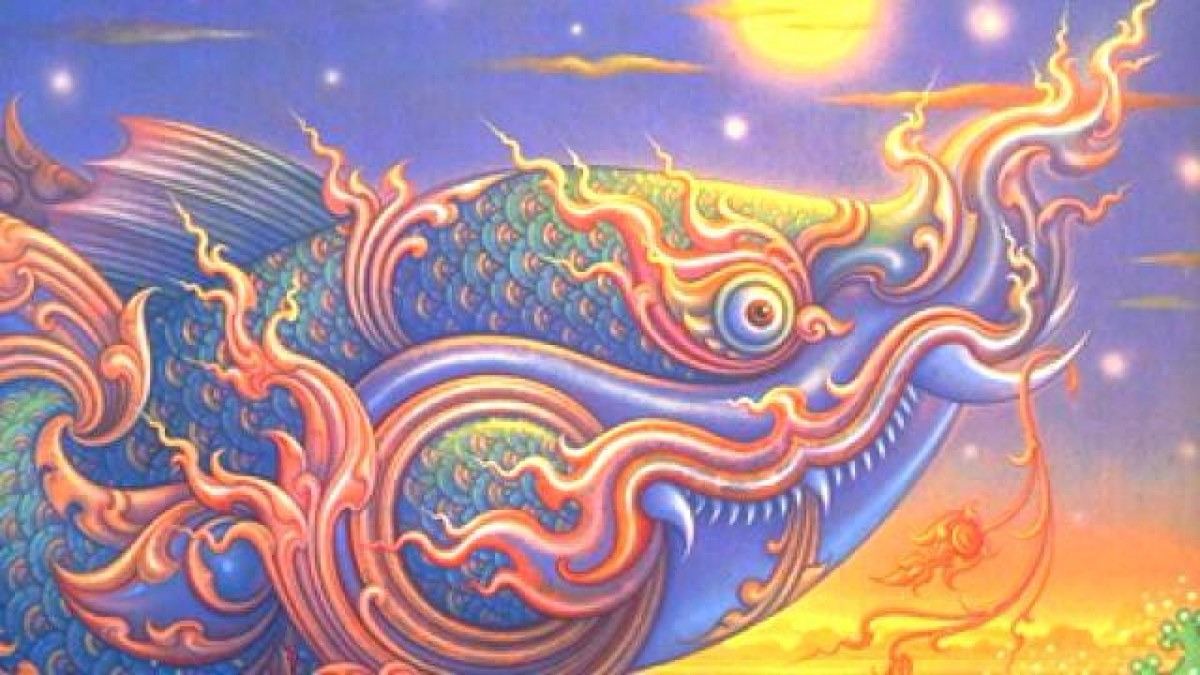
A giant fish that can cause an earthquake when it turns over.
นารีผล Nariphon
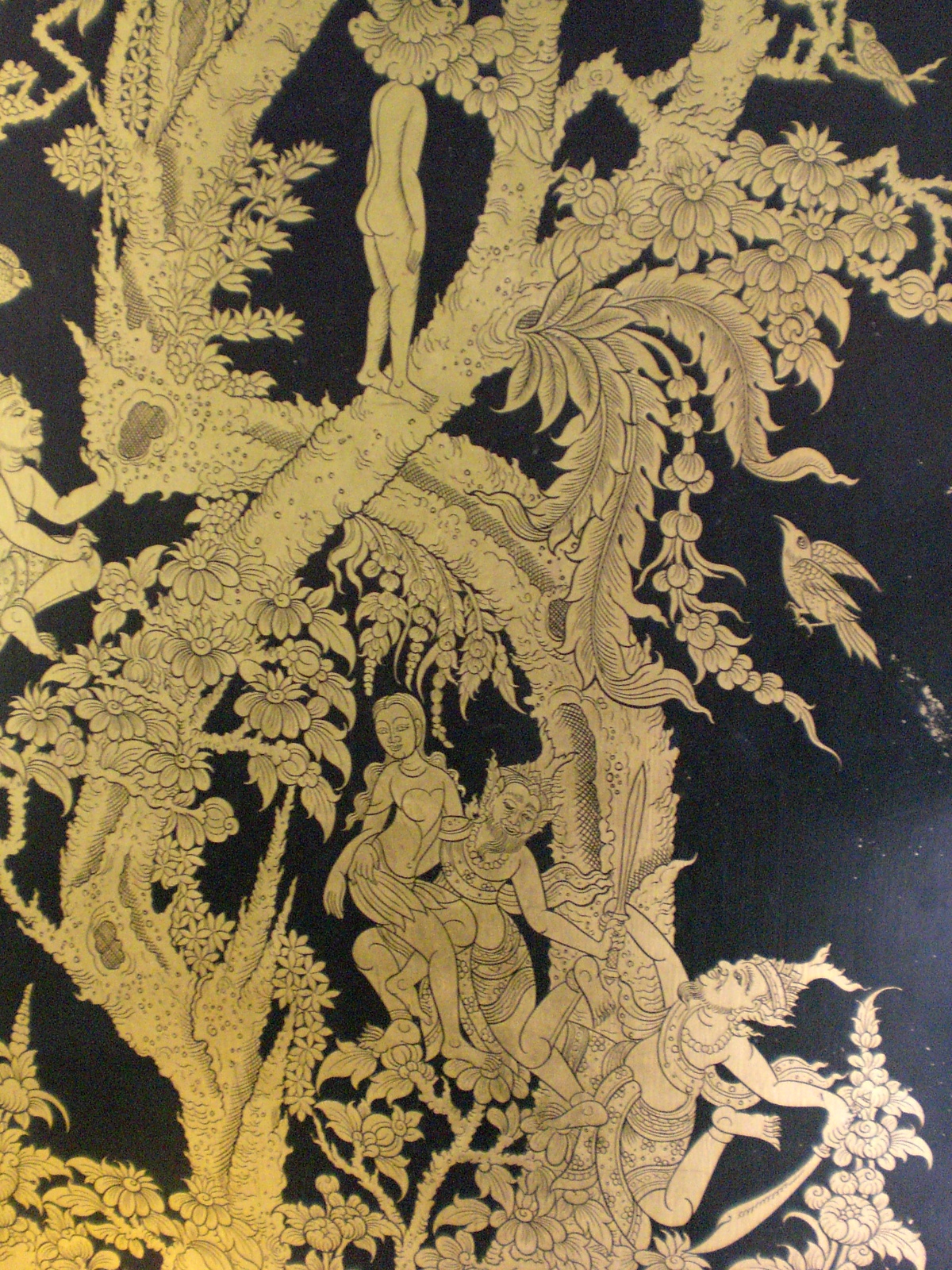
Naripon is composed of two words: Nari (woman) and Phon (fruit). It is a fruit that resembles a beautiful girl. They have 7 days before they rot away.
คนธรรพ์ Gandharvas

Heavenly musicians and singers. Servant of a greater deity. They are pretty flirtatious beings and like to take a ripe nariphon for themselves.
I feel like they are always the asshole in every tale they feature.
นกหัสดีลิงค์ Hatsadiling

It looks mostly like a bird, but its beak looks like an elephant's trunk. The Hatsadiling is often used for decoration in cremation ceremonies because it is believed that it can carry the soul of the deceased to heaven.
There is evidence of the use of the Hatsadiling-shaped crematorium in the Lanna and Lan Chang cultures. But in Ubon Ratchathani, there is a specific tradition where they will have a person act as Sita performs the traditional Hatsadiling bird-killing ceremony.
There are a few versions of the tale that influence this tradition, but the highlight is that the woman named Sita kills a hatsadiling that has been causing trouble via arrow.
มอม mom

The Mom creature looks similar to a mixture of many animals, including dogs, cats, geckos, lizards, monkeys, tigers, etc. It has long arms and a long, stretched body similar to that of a reptile. The color of the body will vary depending on the artist. This creature is prominent in Lanna art.
มกร Makorn or Makara
<-the head that is biting naga
It's statue is usually in a state of spitting something out of its mouth. It's look pretty similar to Hera. Often got mixed up with Hera. Some sources say that it IS the same creature as Hera, just an alternative name.
เหรา Hera

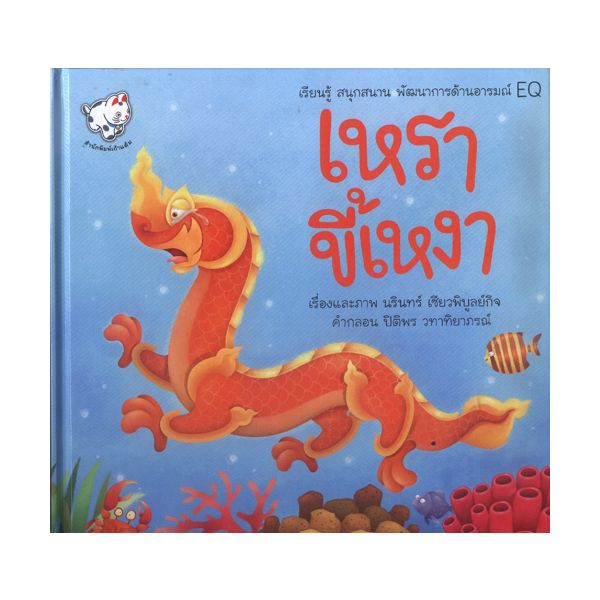
A mix of naga and (Chinese?) dragon, or a crocodile-like creature. It has four feet, and its face has both fins and a crest. It is sometimes described as a different mix, like with Garuda or a horse.
It's tale is that it tries to eat a naga but fails....
There is a statue of Mom and Hera that went viral awhile ago. It's an amateur DIY cement stair railing by a monk. It came out looking very adorable. they even got fan art and goods.
<--Mom
 <--Hera
 <--The good in question.
สิงห์ lion

There are four types of lion-like creatures in the Himmaphan universe. (Not included the lion mix with other creatures.)
- Kraisorn Rajasribody is white like conch shell. Mouth, belly, and feet are red like it is painted with cinnabar mixed with mercury and sulfur dissolved in lac water. Live in a gold or glass cave. It is faster than sound and has a voice as loud as thunder.
- Kala Sriha is black and despises being a lion-like creature. It is an herbivore. Not that it is harmless, though.
- Tinna Sriha has a red body like the legs of a pigeon and is as big as a bull. Also an herbivore. Tinna means grass.
- Bantu Rajasribody is like the color of a yellow leaf. This one is carnivorous.
We use them in government logos, and some of the universities (4) have them as Faculty of Political Science logos. Each university uses a different one.
I found this website when I searched for the English spelling of Kraisorn Rajasri, and it is amazing. So this chapter ends here, lol.
And this website is for art that was created for the King Rama 9 funeral.
https://phramerumas.finearts.go.th/group-items.php?grpID=15
^ from the Fine Arts Department
https://www.thailandfoundation.or.th/culture_heritage/thai-mythical-creatures-where-to-find-them/
^ from the Thailand Foundation