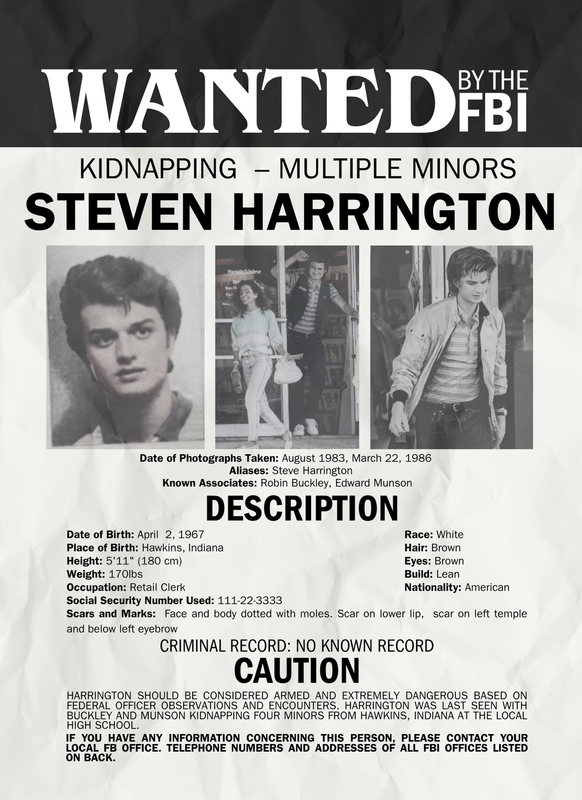
Work Text:

Government Lab at the Heart of Small Town Tragedy—the True Untold Story Behind Hawkins Massacre, Missing Children, Wanted Teens, and Supernatural Earthquakes!!!
By Bartholemew Smitsky—Editor in Chief, The Weekly Watcher
Tragedy always seems to strike idyllic small towns situated in the American countryside. Peculiar ongoings haunting hillsides and small churches with steeples forged from white wood, long since splintered under the howling of high speed winds and tornado warnings. Families of four and five—more if you count the dog—are rushed to safety, their hands clasped together, lips loose with prayer and tight with secrets—never tight enough. Hawkins, Indiana is seemingly no different. Since 1876, it's been lauded by its constituents as, "The perfect place to raise a family this side of the Mississippi!"
And so of course, for the last three years in a row, it's become a hot bed of tragedy, the events seemingly compounding as if pulled in by a gravity of peculiarity. The universe truly clings to its sense of cosmic irony like a cat does a wooden raft on water; claws digging in tight.
Hawkins has had a history as a seemingly run of the mill town. A suburb—in the loosest sense—of Bloomington, where the more well to do and middle class families would keep employment, and a large blue collar population with a long history of working at the local power plants. It also, at one point, boasted prowess in nuclear and medical research through the Hawkins National Laboratory (HNL) run by none other than the Department of Energy (DOE); where many advancements in radiology and even space travel, allowing us to dominate the race to the moon, were made. Though the lab was shut down in late 1984, just a year and a half ago, after chemical leaks were reported to have led to the death of one Barbara Holland in November of 1983.
The sixteen year old girl was previously thought to have run away from home the same week that William Byers went missing. And though, young William was eventually found, alive but in shock, it is interesting to note that both the location of his disappearance and his reappearance can be traced within a one mile radius of the HNL. This is of course not to mention, the dubious circumstances of the police finding a fake body fashioned to resemble the young boy, leading to momentary closure of the case in search of Byers. Upon further research, the day after he went missing, beloved owner of Benny's Diner— located within that same mile radius of the HNL— Benny Hammond was found at his place of business having sustained grievous harm by gun-shot wound. His attacker was never identified, and he maintains that he has experienced retrograde amnesia surrounding the event, though the cops noted that whoever it was, had intended to make it look as though Mr. Hammond committed suicide. The case remains open, despite a lack of leads, and Benny's Diner re-opened in a new location with support from the local community.
After those events, things seemed to have quieted down in Hawkins for a little bit at least, but just one year later, on the anniversary of Will Byers's disappearance, tragedy struck again. It began with reports from local farmers that their crop was dying. Pumpkins that were perfectly sound had wilted overnight and series of tortuous tunnels had formed beneath them, sending the local agricultural economy into chaos. These were of course, in concurrence with the theme of this article, farms that shared water sources with the HNL. Thus at time of publication in December of 1984, when it was revealed that there were chemical leaks in Hawkins, nobody questioned the happenstance. However, perhaps it is the hindsight that allows me to do so, I must say that I find it more than a little unusual that the same mercury that was claimed to have taken Barbara Holland's life—mind you reader, there has not yet been a shred of evidence produced to support that she came in contact with any contaminated water—would be able to turn pumpkins into dust and muck, as well as, create a system of tunnels that had not existed before. I digress however, that this is not even the most peculiar event that occurred during that first week of November.
Setting aside the tunnels and rotting farmland, the denizens of Hawkins have made complaint of odd noises like growling and snarling, some even claiming to have heard, "otherworldly chitters," in the night; especially common complaints in the communities nearer the lab. These noises are said to have spiked the night of November tenth. The same night that a Bob Newby was reported to have died on none other than the grounds of the HNL. Now, his body was never found, and accounts to the likeness of it have been difficult to track down, but it is on good authority that I can say the poor man was most certainly mauled to death. A description would be much too graphic to be provided in good faith, but one must imagine claws and toothy gashes, the manner of which could make even a seasoned surgeon ill. It is only natural to find a connection between Bob Newby's death and the creatures that have created a litany of noises that has kept Hawkins awake over the years. And perhaps these creatures are the very ones that created tunnels underneath the town. Tunnels which seem to extend from where the since-abandoned HNL once stood(felled by the recent earthquakes) to the site of Starcourt mall, which famously burned down this previous summer.
Normally, mall arson, especially on the fourth of July due to a fireworks mishap, would be seen as a non-sequitur. A prank by a known delinquent—William Hargrove—gone awry does not warrant attention from an esteemed publication investigating the supernatural. And yet, the ring of police and military presence around the mall, the recovered materials that were handled by nuclear physicists—the same ones found to have employment at NASA and the HNL—provide indisputable evidence that there is a connection between the mall fire and the other unsavory events that have unfolded in Hawkins. Perhaps it was simply a cover-up to bury the hatchet on the previous chief of police, a man who has been directly involved with all of the aforementioned oddities hitherto. This paper cannot claim to know for sure. I can only point to the mounting pool of evidence that while the town of Hawkins may forget in order to move on and rebuild, these tragedies are not one offs, and rather they are seemingly tied directly to the presence of the lab that stands in the forest at the edge of the town. And it is with this knowledge that one must call into question the recent earthquakes, predated by a serial killer spree, that has now split the town in half.
On Saturday March 22, 1986 the body of Christine Cunningham was found by Wayne Munson. He came about the girl's body in the kitchen of his trailer upon returning home from his night shift. Mr. Munson has long since been cleared of the murder, but, the blame has shifted to his nephew, Theodore Munson—known by his nickname, "Eddie." Though the evidence has been circumstantial at best, most notably, distressing claims by Cunningham's own boyfriend that he saw Munson float Patrick McKinney (another victim preceding the earthquakes) and use satanic magic to kill him. Munson has yet to be found, and the search for him has slowed considerably since his neighbor Maxine Mayfield, a survivor of the killing spree has named a Henry Creel as her attacker. A man who's previous employment record shows direct ties to the HNL. What's more is that Mayfield and her boyfriend, with whom she was at the time of the attack, state that they were at the Creel house. They both deny Munson's presence at the location, instead vouching for his innocence. They were not able to provide us with a statement as to whether or not they believe that the earthquakes are related to the HNL.
However, it remains glaringly clear upon reflection and research that the connection is there. Mayfield's boyfriend, Lucas Sinclair, reports that after Creel finished his attack, Mayfield's heart stopped and that he could not find a pulse. He attempted resuscitation efforts until such time that EMTs were able to arrive. They were however, delayed as massive earthquakes tore the ground in two. Earthquakes that seem to have originated, not along fault lines, but rather at the site of the three murders and one attempted murder (perhaps classified as successful as Mayfield was clinically dead). The nature of these earthquakes is poorly understood by geologists and why shouldn't it be?
There is clearly a metaphysical, even supernatural cause to them. A cause that keeps circling the drain of the Hawkins National Lab.
The article doesn't end there.
But it's been ripped from some magazine that Robin found while she was out earlier and it must have continued onto the next page. Eddie isn't sure that it matters what it goes on to say though. The Weekly Watcher is a conspiracy tabloid paper, and while he doesn't entirely disagree with the conclusions it's made, he knows better than to put too much stock in it. After all, this is the same publication that still thinks Elvis is alive and just hiding, and that Bigfoot is real. Which he had brought up with Robin when she gave him the scrap of paper before locking herself in their bathroom, but she just gave him a glare. Like he should know better than to shoot down theories about the supernatural. Maybe he should. All things considered, if somebody would have asked him about inter-dimensional wizards this time last year he would have thought that they were talking about a D&D campaign, not the events of his upcoming spring break. But what he thinks about the supernatural or what the article says doesn't matter. Not really.
Because it doesn't actually change anything about their situation.
About his life. Not in regard to the things that matter most to him.
His reality is directly at odds with the things he wants, or at least, the things he's wanted. Because the more time that he spends here, the longer that he builds an image of himself, the further from he is from being sure about what's preferable to him.
At the beginning of this whole thing he'd relied on the idea that this arrangement was not permanent. That in a few months time the news would stop talking about them, El would finally destroy the upside down and all of its related threats, and then their names would be cleared.
Those first few weeks were weird. Completely and utterly discombobulating. The three of them—him, Robin, and Steve—were bounced around from property to property while they slowly healed up enough to be ferried across the sea. And then, after the two longest and only flights of his life, followed by a train and taxi ride they'd made it to a house in a suburb in a foreign city. A three bedroom house that was theirs to make themselves at home in for the time being. Or at least that, is what Owens had told them over the phone.
It hadn't been hard to fall asleep the first night they were in the house.
The three of them passed out the second they'd showered, eaten, changed their bandages, and fed Steve's bunnies. They hadn't even made it upstairs for long enough to fight over rooms. Instead, the couch and carpet doubled as a nesting ground for them, and Eddie had woken up to find he had been converted into a bed for two brown, slightly overfed bunnies—one of whom took and continues to take great pleasure in trying to eat the hem off of his Slayer shirt.
It had been nice, despite the pain in his back from sleeping on the floor. But, back then he still relied on the comfort that that sort of arrangement was temporary. That he'd go back to his old life. In fact, that very night, climbing into a bed that was his but still felt wrong, he'd dreamt about leaving it all behind and going back to Hawkins.
He had pictured Wayne and Benny's faces as they picked him up from the airport, or maybe on some nights the two of them were flown out here to help him pack up the meager belongings he'd not had all that long to accumulate. And then, they'd go back to Hawkins together. They'd get a house, one right next to Benny's with a shared backyard so that nobody would know that the three of them lived together. And Eddie would be exonerated. Cleared of wrong doing. Maybe, even, he'd be painted as a hero. That would show goons like Jason.
That was a fantasy and a stupid one. One that didn't even begin to take into account his actual wants. But some nights he lay in bed and thought about it all, spiraling until he'd managed to work Corroded Coffin onto a stupid late night show, like a real sell out.
Which is asinine. Aside from the fact that it's a shallow and childish story that he's crafted for himself over the last few months to help with falling asleep, it has no possible grounding in reality. And why would it? Because he's not so happy in this little dream that he's built for himself. It's small and just like almost every part of his life that's dealt with Hawkins, it's forged from lies.
Lies that feel like they're made of slime on his skin and he wishes earnestly that that sensation was unfamiliar to him. But it isn't. Because his entire life in Hawkins—or almost all of it—has taught him to hide behind different facades, creating new synthetic and overblown visages.
And now, he isn't all that sure that he wants to go back to doing that.
He's just so sick of living in hiding.
And there's an annoying, rational part of his brain pointing out that, that's what he's doing now. But this is a different kind of hiding.
He's got almost two decades of experience for him to constitute as an expert on the matter.
He knows that the phrase, "living in hiding," conjures up imagery of destitution, of starving on the outskirts of a town, moving under the cover of trees at night, having to hold your breath lest somebody gets too close and discovers your whereabouts.
He would agree that that particular image is certainly a way to live in hiding. And in no way is it dramatic for him to say that gets that lifestyle. After all, he's been there and done that.
The last week of March he was mostly alone and he passed the seconds of the day consumed with the fear of the unknown, an anxiety of being caught for crimes that he hadn't committed—mostly, he totally had intended to sell schedule I substances—and a continuous highlight reel of hell's worst hits.
Eddie will never be able to wash the sound of Chrissy's bones breaking and her eyes popping out from her skull, from his mind. Though he thinks now, he may prefer that to reliving getting eaten alive, at least he couldn't feel Chrissy's pain when she died. Either way, back then he'd spent a sure enough amount of time living in hiding. And that meant nobody to take his mind off of the things he'd seen in his trailer that night. Just him, Rick's boat house, and fleeting moments where Hawkins's own Scooby Gang trauma dumped on him, assuring him that things could in fact get worse. It was the perfect storm of cortisol spikes, of flinching at the slightest of sounds, and not allowing himself sleep for fear of waking to Carver or some other well meaning citizen finding him, stringing him up in his slumber.
After that week, hiding also meant a road trip, a new wardrobe, learning a fake history of himself and adopting a fun little accent. It also meant lying around coked out on pain medications—prescription, of course—as Wayne and Benny doted on him and Constance Dorothy Harrington, fat bunny supreme chose to bother him, which made Steve jealous. And for all that that sounds like a relaxing vacation compared to Eddie's previous foray into life on the run, it still consisted of a lot of sleepless nights and panic attacks, thoughts of being found out and killed by some hick with a sense of justice.
And now there's this.
This which is so desperately nothing like that.
Here he's still hiding from the authorities.
He still spends copious amounts of time hoping that nobody's found him out and made a phone call. Here he still sees twisted limbs in the air and blood coating his hands in his dreams. But it's not an acute pain, rather, it's insidious in its chronicity.
It's also getting better by the day, at least he thinks it is.
And in some ways it reminds him of the mundanity of the sort of hiding that he's spent his entire life prior to this spring break doing. It's still different than what he did in Hawkins for years. In the most basic ways of thinking about it, he can't be his authentic and true self. Can't introduce himself as Eddie, can't speak the way that he wants too. He can't be too into his previous interests, but what's new about that? Eddie's always had to masquerade parts of himself. He's lived his whole life shrouding aspects of his personhood. Even when he was his most genuine self the last two years of high school, he was still hiding who he was, is, behind the freak. Behind the hair dye, the loudness, the humor. In other ways this is the least he's had to hide who he is. He doesn't have to pretend to be interested in algebra, he doesn't have to keep his head down in case a jock that peaked in the seventh grade wants to pummel him half to death. He can find soft things cute. He can kiss the guy he likes instead of trying to shove the ideas of doing that down to the depths of his brain. He can make plans of a more definite future.
So he's hiding, but he's not. And he isn't sure that he wants that to end. And the more that he thinks about it, the more that he's pretty sure that there's no real life for him to go back to. There's people in Hawkins for him still, but they'd leave in a heartbeat if they haven't already.
And those people wouldn't care if Eddie Munson was a hero or a murderer, dead or alive, because Theodore Brown is alive and real in all of the ways that Eddie never was.
So he's not sure that he cares about the article or its implication. But he's certain that Robin and Steve might, and he's come to realize in hiding, that he does absolutely care what they think.